
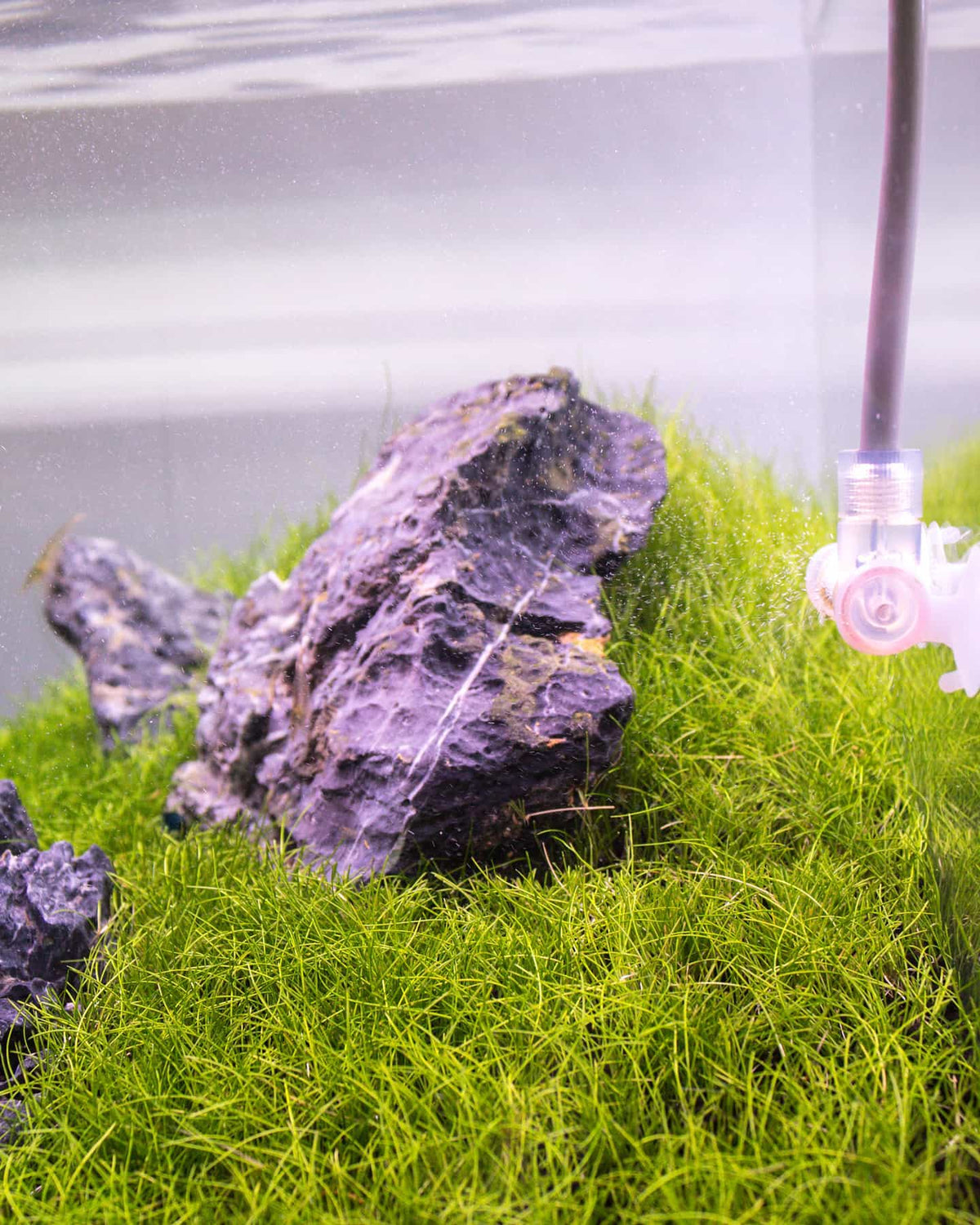
Aqua plants are living plants grown underwater in an aquarium: rosette plants rooted in the substrate, stem plants that are cut and replanted, rhizome plants tied to wood and stone, mosses, floaters and low carpets. Most will grow in ordinary light if you plant them the way their roots expect and feed them. Added CO2 is what raises the ceiling.
What are aqua plants?
Aqua plant is the shorthand shops use for an aquatic plant sold to live fully submerged. They come in a handful of shapes, and the shape tells you how to plant it. Rosette plants such as Cryptocoryne and the swords grow from a crown and root in the substrate. Stem plants grow upwards and are trimmed and replanted. Rhizome plants such as Anubias and Java fern carry their roots on a thick horizontal stem that must stay above the substrate. Mosses attach to hardscape, floaters sit on the surface, and carpeting plants spread sideways across the front.

Not everything in the plant section is truly aquatic. Nursery plants grown in humid air are still sold as aquarium plants under names like lucky bamboo, mondo grass and peace lily; they look healthy for weeks, then rot and foul the water. If a grower does not list a plant as suitable for submersed growth, treat it as a houseplant. The genuine ones reach you in pots packed with rock wool, in sealed tissue-culture cups, or as bare bunches held by a lead strip.
Which aqua plants are easiest to start with?
Start with plants that tolerate mistakes rather than plants that photograph well. The forgiving ones are slow growers with tough leaves: they sulk instead of dying when the light is dim, the water is hard or the feeding is uneven, and they do not need injected carbon to look the way they are supposed to look. Plain fast stem plants are easy in a different sense — they grow quickly enough to show you a problem early, and they take up the nutrients algae would otherwise use.
- Anubias — a rhizome plant for wood and stone, happy in shade, slow enough that algae on its old leaves is a likelier problem than hunger.
- Java fern (Microsorum pteropus) — the same idea in a leafier shape, and it breeds by dropping small plantlets from its older leaves.
- Cryptocoryne wendtii — a rosette plant that melts back after every move, then regrows from the crown and stays for years.
- Vallisneria — ribbon leaves that travel along the back of the tank on runners; give it room and it fills the wall on its own.
- Amazon sword (Echinodorus) — a large rosette for a tank with some depth, and a heavy root feeder, so it wants food in the substrate.
- Bucephalandra — a small rhizome plant with hard, dark leaves; slow, undemanding and well suited to a nano tank.
- Java moss — attaches to anything with thread or glue, shelters shrimp and fry, and forgives everything except trapped detritus.
- Hygrophila and Bacopa — plain stem plants that grow fast in ordinary light and replant from their own cuttings.
| Plant | Where it goes | Light it wants | Added CO2 | How it is planted |
|---|---|---|---|---|
| Anubias barteri | Wood or stone, front and middle | Low to medium | Optional | Tied or glued, rhizome above the substrate |
| Java fern (Microsorum pteropus) | Hardscape, middle and back | Low to medium | Optional | Tied or glued, rhizome never buried |
| Bucephalandra | Small stones, front and middle | Low to medium | Optional | Tied or glued to hardscape |
| Cryptocoryne wendtii | Middle ground and shaded spots | Low to medium | Optional | Crown level with the substrate |
| Vallisneria | Back wall and corners | Medium | Optional | Crown level; then spreads by runners |
| Amazon sword (Echinodorus) | Centre or back of a deep tank | Medium | Helpful | Rooted deep; feeds from the substrate |
| Java moss | Hardscape, mesh, shrimp tanks | Low to medium | Optional | Tied in a thin layer, not planted |
| Hygrophila polysperma | Back and sides, fast filler | Medium | Helpful | Stems planted singly, trimmed often |
| Rotala rotundifolia | Back; colours up under strong light | Medium to high | Strongly helps | Stems planted singly, tops replanted |
| Monte Carlo (Micranthemum tweediei) | Foreground carpet | Medium to high | Strongly helps | Small portions spaced across the substrate |
What do aqua plants need to grow?
Light, carbon, nutrients and water movement, roughly in that order of how often they go wrong. Light sets how fast a plant wants to grow, carbon is most of what it builds itself from, nutrients are the rest, and flow is what carries both to the leaf. A planted tank fails when one of them runs far ahead of the others: strong light over plants with no carbon and nothing to eat is the standard recipe for algae, and it is far more common than the opposite.

How much light do aqua plants need?
Enough, for the same period every day. The low-light plants — ferns, Anubias, Cryptocoryne, mosses — grow under modest lighting and prefer it to a bright tank with no carbon. Stronger light suits stem plants, red plants and carpets, and it raises what the tank asks of you in the same breath. Put the lights on a timer and start with a shorter period than you think you need; the hours to start from are 6 hours a day. Daylight falling on the glass is not lighting, it is algae.
Feeding the roots and feeding the water
Aqua plants eat from both ends, in different proportions. Rosette plants and swords are root feeders and do best in a nutrient substrate, or in plain gravel with root tabs pushed underneath them. Ferns, mosses and Anubias have no substrate to draw on at all, so they take what is dissolved and need a liquid fertiliser. Most tanks want a complete one covering both the main nutrients and the trace elements; dose it by the bottle's own instructions for your tank volume.
Do aqua plants need added CO2?
No. Plenty of tanks are planted, green and stable with no cylinder anywhere near them, and the plant list above is written for exactly that tank. What injected CO2 changes is the ceiling. Carbon is the nutrient plants need most of and the one least available in still water, so adding it lets them use the light they are given: growth speeds up, leaves come in larger and denser, reds colour properly, and the demanding species become possible rather than merely alive.
The honest trade-off is that gas raises the stakes. A tank growing fast needs feeding, trimming and water changes on a schedule, and a level that swings is worse for plants than no gas at all, because instability is what algae waits for. The cheap way to see what is really happening is a drop checker hung where the flow reaches it: blue means too little, green is the working range, yellow means you have gone too far. Read it in the afternoon rather than first thing in the morning.
What a CO2 setup for plants looks like
Three pieces do the work. A regulator holds a steady output as the cylinder empties, and a dual-stage regulator with an integrated solenoid also lets a timer shut the gas off at night, when the plants cannot use it. A needle valve and bubble counter set the rate and let you see it. A diffuser breaks the gas into a mist fine enough to dissolve before it reaches the surface: an inline diffuser sits on a canister filter's hose and keeps hardware out of the aquascape, while an in-tank diffuser mounts on the glass with a suction cup. Join them with CO2-resistant tubing, because ordinary airline hardens and leaks.

Set it low and bring it up slowly. Start at a rate you can count by eye — the starting bubble rate for your tank size is 1 bubble per second* — then give the tank a couple of days at each step while you watch the drop checker and the fish. A ceramic diffuser also needs a working pressure before its membrane will mist properly, and the figure for CO2Art diffusers is 40-50 psi*; below it the gas dribbles out in large bubbles that surface without dissolving. In-tank diffusers are sold in sizes, and the tank volume that divides them is 250l (for Bazooka Diffuser) and 150l (for IO diffuser).
How do you plant aqua plants so they root?
Unpack first, plant second. Take the plant out of its pot and peel the rock wool off the roots: left in, it traps water that goes stale and it stops roots spreading. Rinse tissue-culture plants until the gel is gone, because the gel clouds the water and feeds bacteria. Shorten long roots with scissors — they regrow, and a short root goes in without folding back on itself. Then split the pot into several portions rather than planting it as one lump, because portions planted apart grow towards each other while a lump shades its own middle.
After that, plant by type. Rosette plants go in with the crown level with the substrate surface and never buried; bury a crown and it rots. Stem plants go in one at a time, each pushed deep enough to hold, spaced about a finger apart so light reaches their lower leaves. Rhizome plants are not planted at all: tie or glue Anubias, Java fern and Bucephalandra to wood or stone with the rhizome in open water and the roots free to grip. Mosses are tied flat in a thin layer, since a thick pad dies underneath.
Trimming and making more plants
Trimming is how a planted tank is kept, not a sign that something went wrong. Cut stem plants above a leaf node and replant the healthy tops; the cut stem branches and thickens where it was cut. Take a whole leaf and its stalk off a rosette plant at the base rather than cutting the leaf in half. Ferns and Anubias are divided through the rhizome, each piece keeping roots and leaves. Net the floating scraps out afterwards and change some water after a heavy trim.
Why aqua plants melt, yellow or gather algae
Most plant trouble in a young tank comes from a short list, and the symptoms look alike through the front glass. Work through them in this order before buying anything.
- Melting in the first weeks — normal. Shop plants are grown in humid air and shed those leaves to grow submerged ones. Keep the water clean, uproot nothing, and watch for small new leaves at the base.
- A Cryptocoryne collapsing all at once — the classic crypt melt, usually after a move or a sharp change in the water. The roots survive; remove the mush and wait.
- A rhizome plant going soft — its rhizome was buried. Lift it, cut the rotten part away and tie what is left to hardscape.
- Old leaves yellowing while new ones come in fine — a feeding gap rather than a light problem. Start or raise the liquid fertiliser and push root tabs under the heavy rooted plants.
- New tips stunted, twisted or pale — unstable carbon or missing trace elements. Check that the gas comes on at the same time daily and that the mist reaches the far end of the tank.
- Stems stretching to the surface with bare lower stems — too little light getting down, often because taller plants have grown over them. Trim what is shading before you buy a brighter lamp.
- Algae on the slow plants' leaves — the surplus the plants did not use. Shorten the lighting period, steady the gas, feed the plants and keep the water changes up.
- Nothing grows and the water is clear — flow. Follow where the filter output actually goes; plants starve in the corners the current never reaches.
Frequently asked questions
Do aqua plants need CO2?
No. Java fern, Anubias, Cryptocoryne, Vallisneria and mosses grow well with no cylinder, as long as the light is modest and they are fed. Injected CO2 lets plants use stronger light, which is what makes carpets, red plants and fast dense growth possible.
Which aqua plants grow in low light?
Java fern, Anubias, Bucephalandra, Cryptocoryne, Java moss and most floating plants. They are slow growers with tough leaves, so they hold their shape under modest lighting. Their weakness is algae on older leaves rather than hunger, which a shorter lighting period usually settles.
Why are my new aquarium plants melting?
Because they were grown above water at the nursery and are now switching to submerged leaves. Melting in the first weeks is normal and is no reason to uproot anything. Remove the rotting leaves, keep the water clean and look for small new growth at the base.
Can aqua plants grow in plain gravel?
Many can. Rhizome plants, mosses and ferns never root in substrate at all, and water-column feeders take what is dissolved. Heavy root feeders such as swords and Cryptocoryne do better in a nutrient substrate, or in gravel with root tabs pushed underneath them.
How often should aqua plants be trimmed?
As often as they outgrow their place: fast stem plants weekly once established, rosette and rhizome plants only when a leaf ages or blocks the view. Trimming little and often beats one hard cut, and the trimmings replant straight into any bare spot.
When the plants outgrow what the tank can give them, our complete CO2 kits put the regulator, the diffuser and the tubing together, so the only decision left is whether the diffuser goes on the hose or in the tank.
Sources
- Tropica Aquarium Plants — plant catalogue and care labels
- Flowgrow aquatic plant database
- European Commission — invasive alien species of Union concern
- Our own product pages for the figures marked with an asterisk (*)
Partager:
Tapis de pearl weed : comment cultiver le Micranthemum micranthemoides